



Electric Pergola: Motor Quality That Won't Jam in November

- IP65-sealed motors with high-ratio self-locking gearboxes prevent louvre creep in 118 km/h (73 mph) Beaufort 12 winds.
- Marine-grade stainless steel pivot pins last 10+ years in UK salt air; zinc-plated alternatives corrode within 3–5 years.
- Solid aluminium footplates eliminate rust staining on patios; budget steel equivalents bleed orange within two years on coastal plots.
- Pergola 4 Pro's 320 kg/m² snow load rating proves structural margin — motors stay reliable because the frame isn't being stressed.
- One tap on your phone closes the louvres on a wet November morning; budget motors with standard gearboxes jam by October.
What does 'electric pergola' actually mean - and which type are you comparing?
Search "electric pergola" and the results mix three genuinely different products. They share a motor and an outdoor setting - that's where the similarity ends. Getting clear on which type you're evaluating before you request a quote will save you time and prevent an expensive mismatch.
- Motorised retractable awning. A fabric canopy that extends and retracts on a roller, driven by a small motor. Provides shade on still days. Must retract in rain or wind, offers no structural frame for lighting or walls, and leaves your furniture exposed the moment the weather turns. These are the cheapest "electric" option - and the most limited.
- Louvered pergola with a motorised roof. A permanent aluminium structure with a set of rotating slats across the top. One button tilts the louvres to any angle from fully open to fully closed, giving you weather protection, ventilation control, and light management in a single movement. The structural frame supports add-on accessories like Glass Walls or heaters. This is what most serious buyers mean when they search "electric pergola roof".
- Smart-home-integrated louvered system. The same louvered structure, but with a control protocol - Matter & Thread, for example - that connects the motor to Apple Home, Google Home, Alexa, or SmartThings without a proprietary hub. The roof responds to schedules, sensors, or voice commands.
Most content treats types 1 and 2 as interchangeable. They aren't. A retractable awning closes up when it rains; a louvered pergola roof closes because it's raining, keeping the space dry below. That structural difference is the reason you're still sitting outside on a wet Tuesday in November rather than watching the garden from the kitchen window.
The honest tradeoff: a motorised louvered pergola costs more than an awning. A mid-range awning runs £1,500–£3,000 installed; a well-engineered louvered structure with a motorised roof sits above that. The Pergola 4 is the manual baseline if you want to compare motorised versus non-motorised cost difference before committing to the full electric spec.
This guide covers types 2 and 3 only - specifically, what separates a motor that holds up in a damp British winter from one that jams by the end of October.
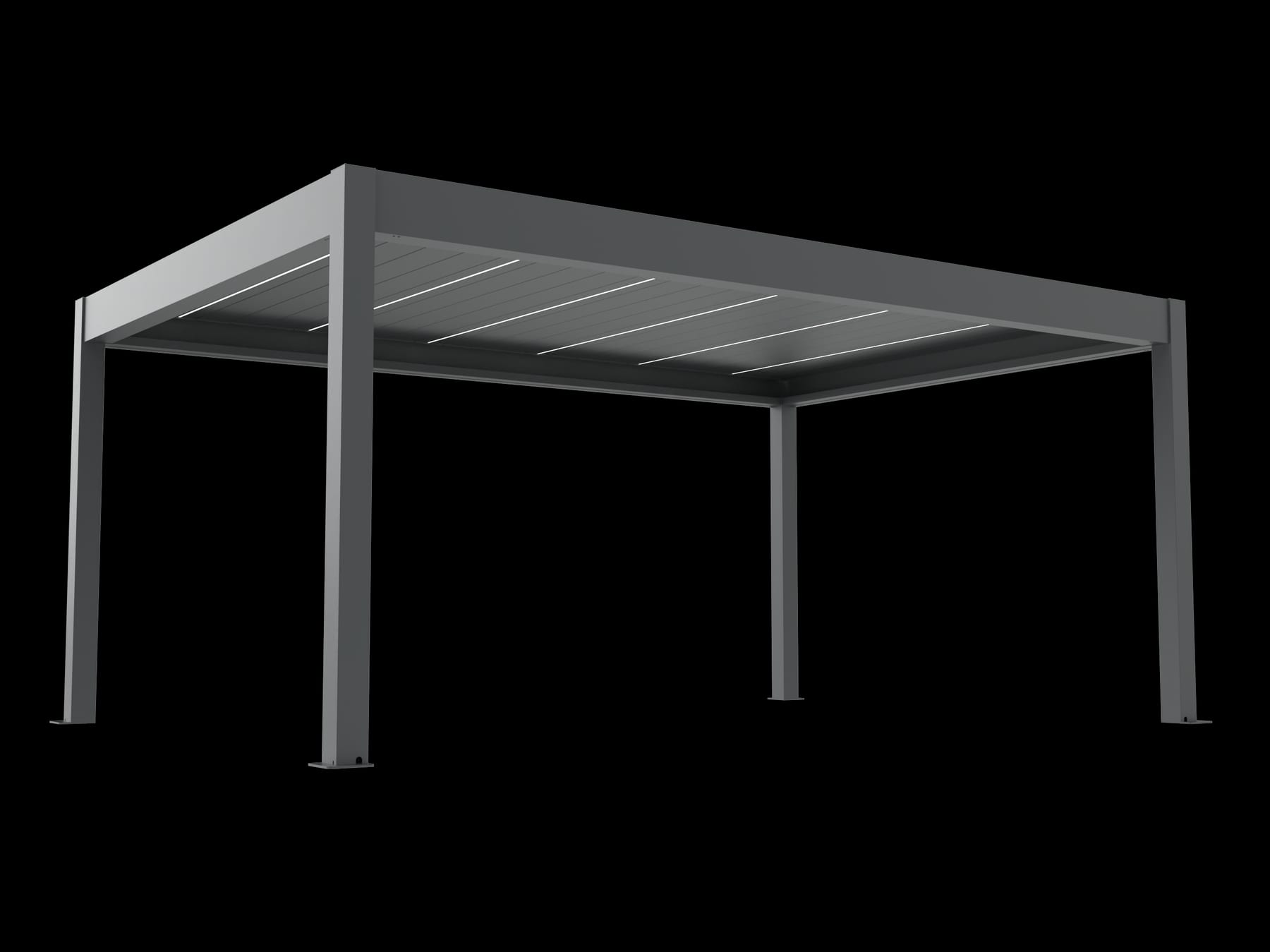
How do you tell a reliable motor from one that jams on a wet November morning?
The honest answer is: ask about the motor housing, the gearbox, and the fasteners. Most suppliers won't volunteer this information. The ones who can't answer it quickly are telling you something.
Start with the motor housing. The Pergola 4 Pro uses IP65-rated motors - hermetically sealed against dust and sustained high-pressure water ingress. That matters in the UK not because of dramatic weather events but because of the ordinary ones: three weeks of persistent drizzle in October, wind-driven rain off the North Sea, salt-laden air on a coastal install in Cornwall or Norfolk. A motor rated below IP65 doesn't fail in a thunderstorm. It degrades incrementally through November, December, and January until the morning you press the button and nothing happens.
Then ask about the gearbox. Budget motors use standard gearboxes that allow slight back-drive - meaning louvres creep open under sustained wind gusts, even when you've set them closed. The Pergola 4 Pro uses a High-Ratio Self-Locking Gearbox: the mechanism physically cannot back-drive, so the louvres stay exactly where you positioned them through a Beaufort 12 storm at 118 km/h (73 mph). This is also why the motor doesn't have to fight to hold position - it simply locks, which prolongs motor life considerably. On a wind resistance guide basis, that certification isn't a marketing figure; it's the same standard used for structural rating in coastal building applications.
The pivot pins are marine-grade stainless steel. That's not a detail you'll find on most spec sheets, but it's the component that articulates every time the roof opens or closes - potentially thousands of cycles across a decade. Zinc-plated equivalents on budget units begin to corrode within 3–5 years in UK salt-laden air, leading to stiff operation and eventual seizure. You won't notice it in year one. You'll notice it in year four.
The same logic applies at ground level. Budget units ship steel footplates that bleed orange rust staining onto patio slabs within two years of install. PERGOLUX footplates are solid aluminium - no ferrous content, no rust, no staining. On a coastal or riverside plot, this distinction is not cosmetic.
The Pergola 4 Pro is also TUV-certified for a 320 kg/m² snow load - roughly 2,900 kg on a 3 × 3 m roof. That figure is not relevant to most UK gardens. It is relevant as a proof of structural margin: a structure engineered to handle loads well beyond what British winters produce is, by definition, not being pushed anywhere near its limits by an average autumn in the Midlands.
The tradeoff is upfront cost. This level of sealing, gearbox engineering, and hardware quality costs more than a budget unit. What you're buying is the confidence that the motor works on a wet Tuesday morning in November - not just on the August bank holiday when you installed it.
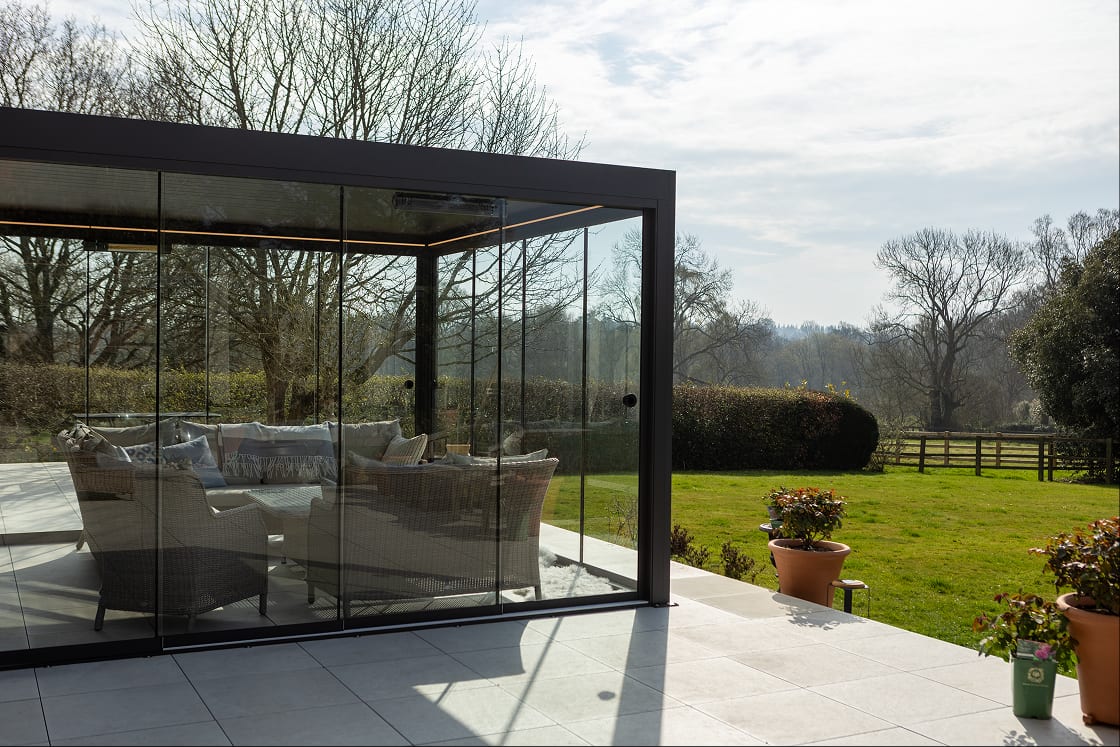
What does smart-home control actually look like on a Tuesday morning in October?
Not a showreel. You're making coffee, the sky has shifted from overcast to drizzle, and you want the louvres closed without going outside. On the Pergola 4 Pro, that's one tap on your phone or one button on the remote - whichever is closer. No separate app to open, no bridge device to wake up first.
The reason it works without friction is the control protocol. The Pergola 4 Pro runs Matter & Thread natively - the same open standard that Apple Home, Google Home, Alexa, and SmartThings all speak. There is no proprietary hub, no third-party account, and no ecosystem lock-in. If you already use any of those platforms, the pergola appears in it the same way a smart light would. If your home isn't automated at all, you use the included remote and the app, and you lose nothing.
Competitors often sell "smart" control that means a branded app tethered to a single cloud service. Change your phone, change your platform, or lose your Wi-Fi for a week - and control breaks. Matter & Thread sidesteps that entirely because the protocol runs locally, not through a vendor's server.
UK period properties add a specific complication here. Stone walls, thick brick, and original glazing absorb signals that would pass straight through a modern build. The Pergola 4 Pro carries a high-performance external antenna engineered to penetrate stone facades and glass doors - which matters if your garden is separated from the kitchen by a Victorian extension wall.
The centralised control hub uses a medical-grade processor. That framing isn't marketing - it means the component is rated for continuous, unattended operation rather than the intermittent-use components that cheaper systems rely on. The honest tradeoff: Matter & Thread integration is more capability than most homeowners will use in the first year. If your smart-home setup currently extends to a single voice assistant and a couple of bulbs, you won't feel underserved by the remote. The integration is there when you want it, invisible when you don't.
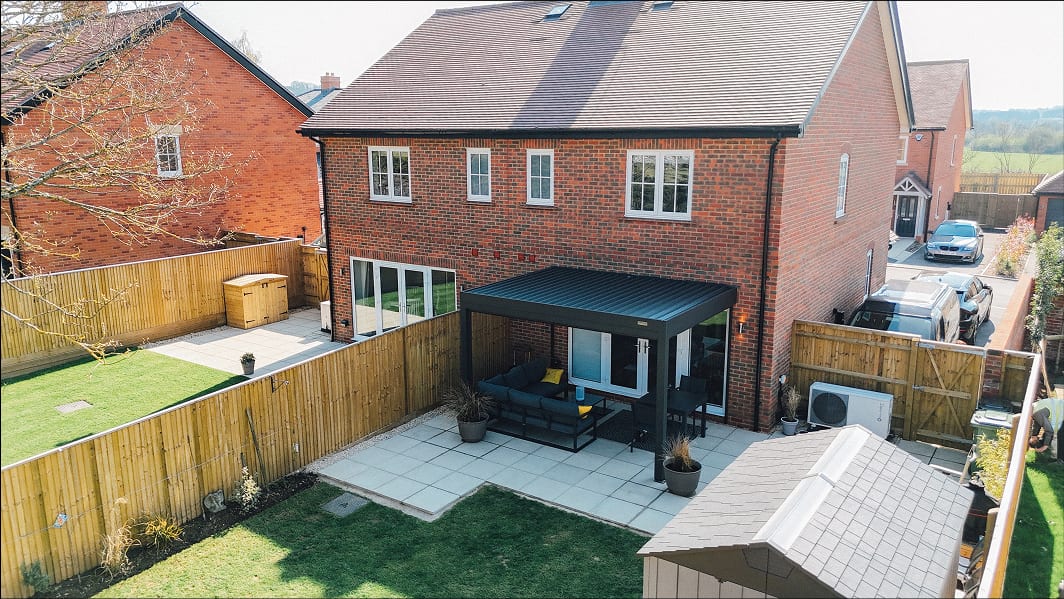
Does the 130° louvre rotation actually matter in a British garden?
For most of the year, yes - and the reason is specific to this latitude. Between September and April, the sun barely clears the roofline by mid-morning. A pergola with a 90° louvre range can only open parallel to the ground or close fully. That binary choice means you're either blocking everything or letting in vertical midday sun - which in October arrives for roughly two hours before the angle drops again.
The Pergola 4 Pro rotates to 130°. Those extra 40° let you tilt the louvres past horizontal and face them directly toward low-angle morning and evening light. The practical difference: the space underneath fills with soft angled light at 8am in October rather than sitting in shade until noon. From inside the house, a 90° system reads as a dark ceiling for most of the working day in autumn. A 130° system reads as a continuation of the room.
This is also why the Self-Locking Gearbox matters here. A wider rotation arc means the motor travels further through more mechanically demanding positions - particularly near the 120–130° end of the range where gravity pulls against the slat. Without a locking gearbox, louvres drift back under wind pressure before they've had time to earn that position. The gearbox holds the angle the motor set, not the angle the weather prefers.
The tradeoff is real: a 130° range puts more demand on the motor across its full sweep. That's a reason to choose a system with a self-locking gearbox, not a reason to settle for the shorter arc. If the supplier you're evaluating can't confirm their gearbox mechanism, the shorter range isn't a feature - it's the ceiling of what their motor can reliably manage.
An electric pergola roof that only works well on clear July afternoons is not the investment the research phase suggests. The 130° range is what makes the motorised pergola worth using on a grey Wednesday in March - which, in a British garden, is most of the calendar.
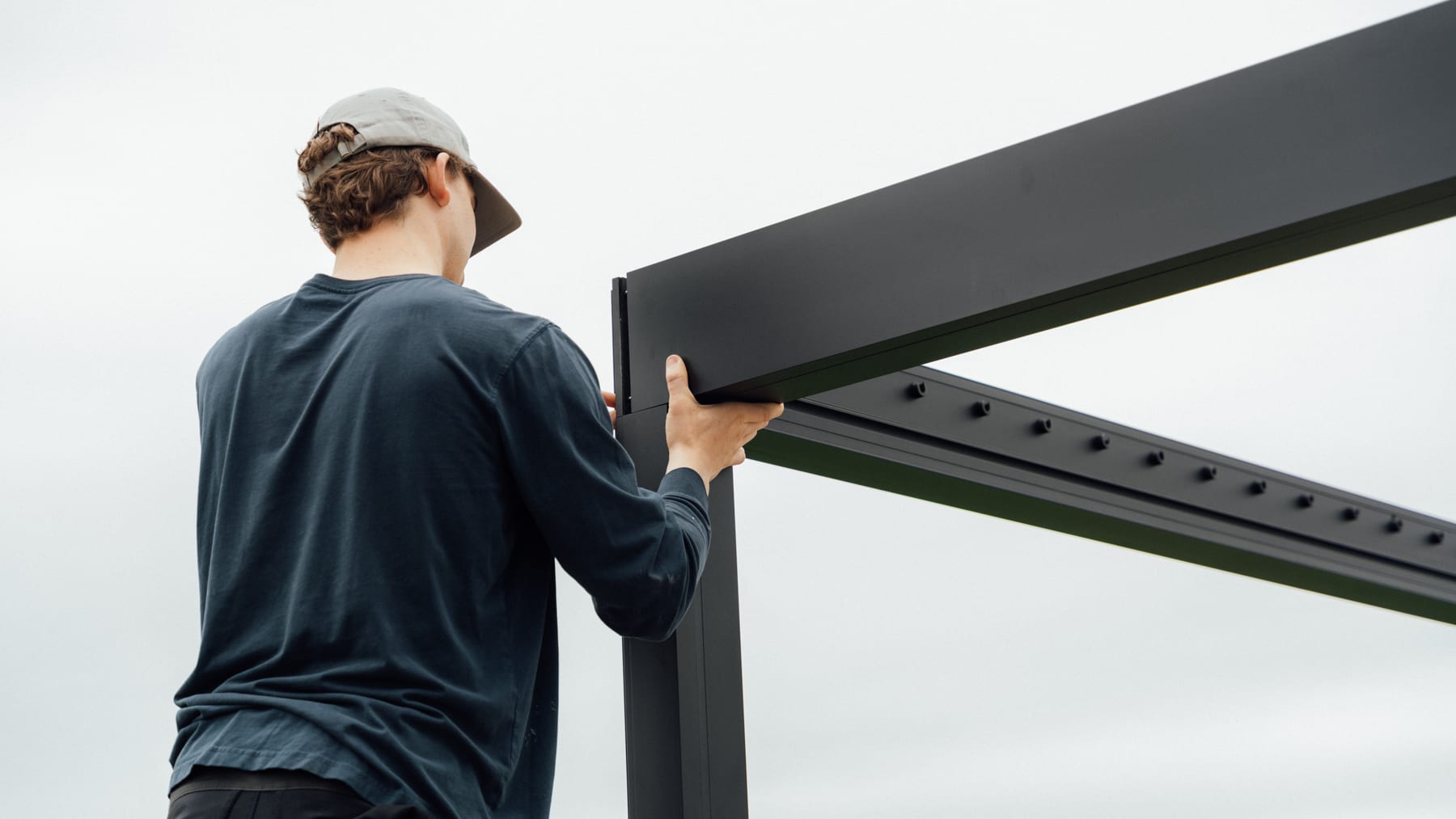
Can you realistically install an electric pergola yourself - or do you need a contractor?
Yes - two people, one weekend, no construction crew required. That's not a marketing claim; it's a function of how the roof system is engineered. The RapidLouver™ snap-in system brings each motorised louvre into place in around 15 minutes. Competitor systems that require individual bracket alignment and torquing typically run to approximately 4 hours per slat. On a full-width roof, that gap compounds quickly.
The motorised variant doesn't add wiring complexity at the louvre level. Each slat connects mechanically via the snap-in mount; the electrical side runs through a centralised hub rather than individual wiring per louvre. You're not running cables across the roof - the motor arm links to the hub at one point, and the rest is structural assembly.
The finish holds during that process. AkzoNobel powder coating carries a 100/100 adhesion score and a Hardness Score of 90 - it won't chip when you're rotating a section into position or manoeuvring the frame against a wall. The 6.3 mm elasticity rating means it survives the temperature cycling between a cold garage and a warm afternoon install without spider-web cracking. That matters when you're handling sections more than once during a weekend build.
Once the structure is up, the same DIY logic applies to enclosing the space. Adding Glass Walls for autumn and winter use is a direct extension of the install - no additional groundwork, no new anchoring. It's the step most owners take in the first season once they realise the roof alone doesn't stop the wind cutting through at 5 °C.
The honest tradeoff: you need two people and enough access around the perimeter for ladders. A terrace hemmed in by a rear extension, a boundary fence within a metre, or a raised deck with limited clearance below may make the structural anchoring genuinely awkward to do safely without a professional. That's the access question to resolve before ordering, not after delivery. If you're still working through the site specifics, the buyer's checklist covers the measurements and access requirements worth confirming at the planning stage.
Back to Blog